 Recently a physiotherapist asked me to stand, feet apart, facing a mirror. When I did, she said, “Your feet are slightly turned inward.”
In the mirror I saw my feet aligned in Tadasana. I then repositioned them to show my natural alignment, a bit more outwardly turned (yet still more or less parallel).
That made me reconsider my Tadasana feet: To avoid excess turnout (a common misalignment), have I been overdoing it the opposite way?
Determining whether feet are parallel requires observation of the “midline” of the foot–a line between the second and third toes to the mid heel. If your feet are narrow and oblong, both inner and outer edges will be parallel, along with the midlines. If your feet are wedge shaped like mine, the outer edges will angle outward even when the midlines are parallel.
In classic Tadasana, the feet stand side by side and thus cannot turn inward beyond the body’s midline or sagittal plane. Likewise, standing with a block between the feet parallels their inner edges. So, why do many yoga practitioners toe in farther? In some poses, such as Prasarita Padottanasana, we’re often taught to parallel the outer feet, causing a pigeon-toed stance. While it’s wrong to point the toes outward, isn’t the opposite also detrimental?
For more food for thought, read Palo Alto-based posture expert Esther Gokhale‘s highly informative (and visually compelling) book 8 Steps to a Pain-Free Back. She recommends standing with feet and legs a bit externally rotated (to ground the outer soles; to lift the inner arches), based on years of comparative anatomy/kinesiology research.
Sometimes an opinion from outside the yoga world can be thought-provoking. Whether right or wrong, it forces us to rethink our assumptions and habits.
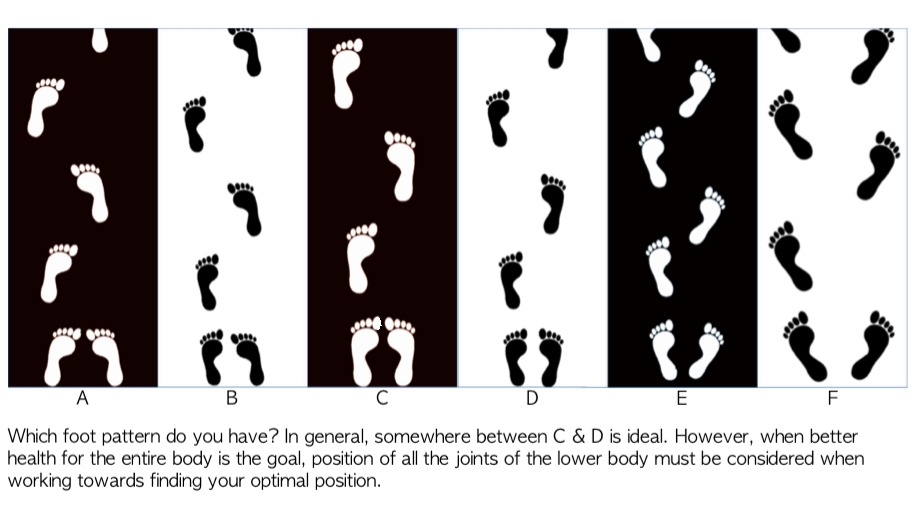
Image: foot cross-section, Delta Orthodics; foot patterns, Leslie McNabb


 Yoga Spy
Leave a Comment