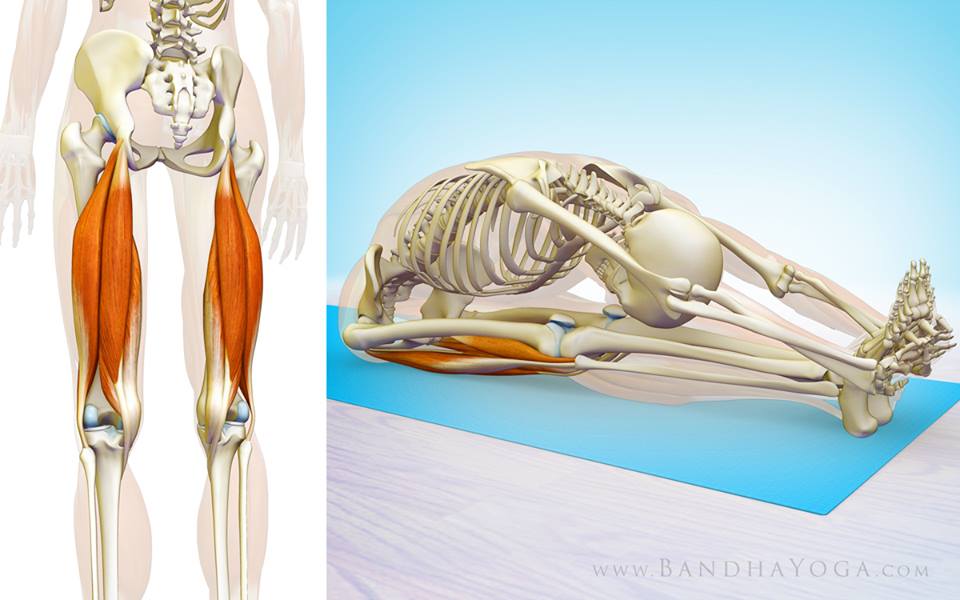
In early 2014, I strained a left hamstring muscle near the origin. Or an external rotator in the left hip. Or something. It snuck up on me. There was no acute injury.
I simply noticed less range of motion (ROM) in straight-legged, forward-bending poses, marked by a pulling sensation on the lateral side of the sitting bone. Initially I was sure that whatever I’d tweaked would resolve in a few weeks, as my injuries typically do.
By April, however, it was still bothering me. While not prohibitive (I continued to attend weekly classes, to teach m own classes, to “do everything”), my more-flexible left leg suddenly had less ROM than my right–and that grippy spot persisted.
A habitual self-diagoser, I looked up other possible conditions. Could it be piriformis syndrome? Could it be sciatica? (Since I had no nerve-related symptoms, I ruled out these conditions, which apparently are common among runners.)
Here’s a short list of remedies I tried:
- Ice I’m a fan of ice/cold therapy. So, if the area was tender, I’d sit on an ice pack (not everyone’s cup of tea). Ideally I would have alternated cold and hot packs.
- Rest I never took complete rest, I initially held back in my forward bends. Over time I found that rest was either unhelpful or neutral. I was reminded of senior-level Iyengar yoga teacher Chris Saudek‘s answer to a question about healing an injury. She said that she first tries rest but, if she sees no change, she does the opposite and intensifies her practice.
- Massage I splurged on three massage therapists with high hopes of finding a miracle worker. The first, known for deep myofascial release, was knowledgeable but spent more time on diagnosis than on massage. The second therapist was a bit too New Agey for me, and the third was good but not great.
- IMS My final experiment was Intramuscular Stimulation (dry needling) done by a physiotherapist. I have pretty high pain tolerance, thank goodness, because IMS is excruciating! But I found it curiously cathartic. Did my four treatments help? Possibly. I resumed kicking up to handstand with my left leg (after a couple of months’ kicking up only with my right).
In July I left for India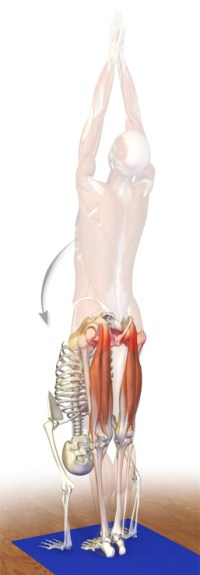 , hoping for the best. In Pune, I practiced more than I do back home. There were times when I had to modify: In Trikonasana, I used a block while the majority were prop-free, fingertips on floor. In Paschimottanasana, I did a 45-degree concave forward bend while others rested forehead to shins.
One day, while practicing Supta Padangusthasana I, II, and crossover (two-minute holds per variation per side), I repeated the first upright variation (my usual “test”) found that it felt different after the series. The target spot at my left outer hip felt more diffuse, and I had more ROM. The parsva (side) and crossover variations seem to release the grip on my hamstrings–perhaps by engaging my psoas or by resetting my femur head in its hip socket. (See Ray Long’s articles, linked below, on optimal stretching techniques.)
From that day, I did this Supta Padangusthasana series daily and, by the time I returned to Vancouver in early September, I had turned a corner. My left leg was almost back to normal, and I didn’t feel that pulling restriction anymore. Then–a big sign–I could “pop” my left hip joint again. During my injury, it had stopped popping; I missed that visceral release and was thrilled when it returned!
Today, my left leg is as flexible, or more so, than my right. It took seven or eight months to heal. Diagnosis? With nagging “minor” injuries, there’s rarely a clear-cut answer. By changing our mechanics, our routines, or our attitudes, we must find our own solution.
Further reading by Ray Long, Bandha Yoga:
Images: Paschimottanasana, Bandha Yoga on Facebook; Uttanasana, Bandha Yoga


 Yoga Spy
Leave a Comment