Note-Taking During Yoga Class

Published by

on

One day, I noticed my student Nicole jotting handwritten notes during class. She hadn’t previously done so. I steered her back to the pose, without directly addressing her note-taking. Later, she revealed that she has trouble with attention. She thought that taking notes might enhance her learning and retention.

Interestingly, I’d rarely, almost never, faced this question. Students either follow existing protocol (no note-taking in class) or prefer not to take notes. Despite a few qualms, I agreed to let her continue.

Second Thoughts

Shortly thereafter, another student approached me after class. “I hate to complain,” she said, “but I was really distracted by the person next to me, taking notes. Maybe if I’d been across the room, I wouldn’t have noticed. But it stood out since it’s not the norm.”

Hmm, I could choose to cope with Nicole’s note-taking, but I couldn’t let it disturb other students. I discussed the situation with my training teacher, gathered my thoughts, and ultimately asked her to stop.

Unspoken Protocol

As a student, I’ve never taken notes in class. Neither in Berkeley, California, where I first studied yoga, nor in Vancouver, British Columbia, where I trained to teach.

No one ever said, “Don’t take notes.” It was an unspoken protocol. None of my classmates took notes. As a beginner, I followed their lead. In those formative years, I was keen, focused, fully occupied just executing the poses. I had no time, no opportunity, to scribble notes.

Later, as a junior teacher, I wanted to remember everything that I learned in class. I wanted to recall sequences, concepts, prop set-ups, clever cues, witty remarks, minutiae important only to me. But I still took it for granted: no note-taking. So I’d memorize the sequence, pose by pose. After class, I’d sit at a café and write it down, beginning to end, adding figure sketches and secret comments.

Do I often reread those notes? No. Rarely, if ever, do I touch my collection of notebooks. Maybe I simply loved the process, the ritual, of sitting at a café, writing, thinking, daydreaming. Note-taking was the coda to a class.

(Although note-taking is not done in regular, weekly classes, it’s often acceptable during large-scale workshops. Maybe the circumstances—senior teacher, special event, unfamiliar crowd—change the rules. But, at such workshops, students might take notes and even photos. Once, during a workshop by HS Arun, a dramatic Indian teacher who uses props in novel ways, students with iPhones were like paparazzi half the time!)

Book Learning Versus Experiential Learning

I could empathize with Nicole. I, too, focus my mind by writing stuff down. With “book learning,” taking notes seems helpful—to understand concepts, to organize my thinking.

But isn’t that type of learning different from experiential learning? Remember my notebooks of class sequences? The act of writing occurred after class, but the note-taking really occurred during class. I prided myself on my “brain training” and accurate memory, but I was probably diminishing my experience in the moment. By taking notes, I ended up with excellent reference material—and I probably boosted my retention. But I’d lost the pureness of experiencing asana via body, not via mind.

Yoga is an experiential field of study. You can’t learn it only from words. It’s learning by doing. If you stop to take notes, you’ve stopped the experience.

Note-Taking Via Camera

Nowadays, cameras are more ubiquitous than pen and paper for taking notes, remembering things, and otherwise recording life. I find myself frequently whipping out my iPhone to memorialize a moment.

But, during those photo-ops, am I really “in the moment”? During our walks, my dog seems to sigh whenever I hold up my iPhone. She knows that, rather than playing with her, I’ll be staring in her direction, but focused on the boring device in my hands. In that moment, I’m not truly with her.

I don’t regret taking pics and videos. They’re invaluable to me. They vividly refresh my memory; they let me relive moments otherwise lost. But there must be a balance between recording life and just living.

Trusting the Body

Several weeks later, I asked Nicole how she was doing—without note-taking. Fine, she said, still struggling to do any yoga at home, when she can barely recall what we did in class.

“If you don’t have good bodily awareness and coordination,” she said, “you must function in an optimal way to learn through the body. If you’re not in that optimal place, you can feel left behind, lucky if you can remember even one thing from class.”

She has a point. But, unless your main goal is precise recall of particulars, note-taking isn’t necessary. There’s no need to replicate an entire class sequence. You and your body will remember what’s important for yourself.

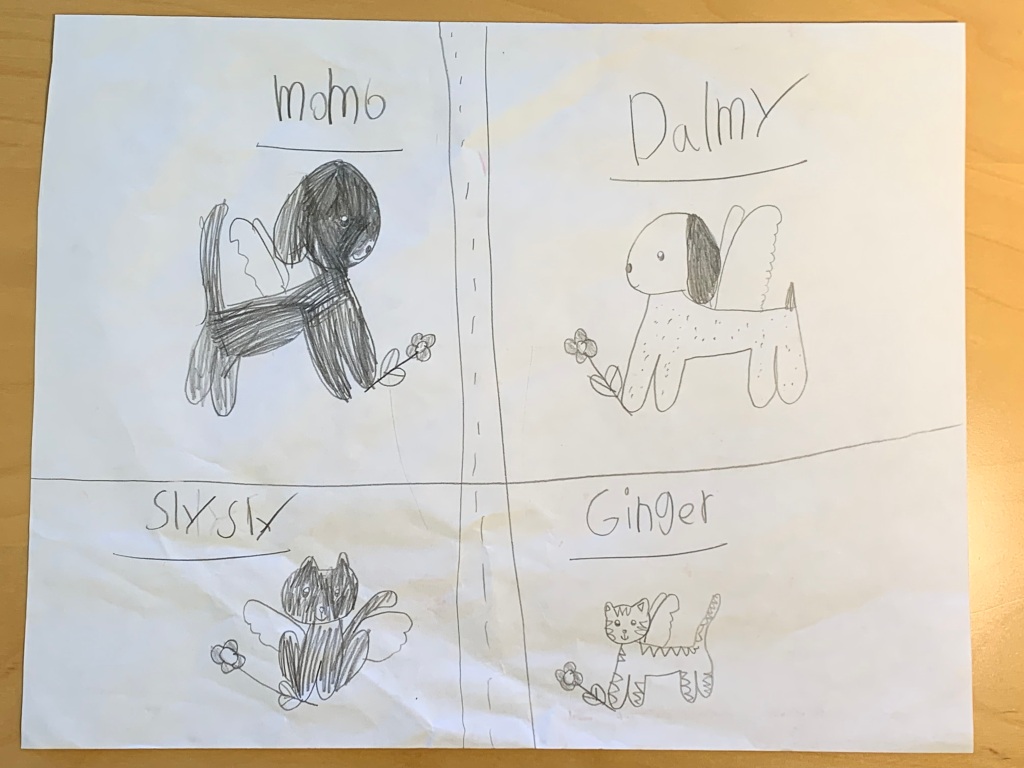
Images: My niece, Tali, has always enjoyed art and loved the pets in her household and in mine. She did the dog and cat sketches around 2011 as a child; the calico cat watercolor as a teen in 2022.

11 responses to “Note-Taking During Yoga Class”

  1. Claire Malone Avatar
    Claire Malone

    Boy do I disagree! I am not at all bothered by someone taking notes in class but picture taking feels really disruptive to me. I am an older person who has trouble remembering sequences after class. If I can just jot down the name of the pose, it would help my home practice. Can’t imagine that brief little activity would bother anyone else. My opinion only. Claire Malone

    Like

    1. Luci Yamamoto Avatar

      Thanks for your comment, Claire. I agree about picture taking, which I never allow. Disruptive and invasion of others’ privacy. Note-taking can be discreet (and useful), yes, but it does change one’s in-class experience. I can see both sides.

      Like

  2. jaynellj Avatar
    jaynellj

    Hi Luci, you always seem to be at the right place at the right time. Our yoga zeitgeist? I fully concur—especially that it trains the brain to recall the sequence, tips, tricks, and turns of phrase to be recorded later. However I too have a bookshelf of yoga notebooks that I rarely look at. Perhaps the act of training the brain to remember was intrinsic in the body doing the yoga to fix it into the cells. Please keep your observations coming😊

    Like

    1. Luci Yamamoto Avatar

      Those notebooks: Should we keep them “just in case”? Or, as with clothes and shoes, if you haven’t touched them in a few years, should be let them go? Thanks, Jayne, for sharing your thoughts.

      Like

  3. Keith Avatar
    Keith

    I, too, have noticed this phenomenom of taking notes or photos/videos in class—with permission of course—and I also have mixed feelings about this. As a blind practitioner—and even before I became blind—the thought of taking notes or photos in any martial arts, language, dance, or music class was unheard of and considered very rude. Maybe this is our age and culture speaking. But I do think this generation not only allows but encourages tolerance for all bodies, all abilities, all everything. And as a yoga instructor in a social justice program, I find myself adjusting, modifying, embracing the discomfort of how I might feel so that most if not all students can learn. I am laughing while I write this because I only started practicing yoga after I went blind, and I recall how many instructors went out of their way and out of their comfort zone to help me learn. As always, such an interesting and thought-provoking post. Aloha and mahalo, Luci.

    Like

    1. Luci Yamamoto Avatar

      Accommodating “all bodies, all abilities, all everything” is essential to yoga classes, I agree. Iyengar yoga has always welcomed all and even got the not-quite-true rep for being physically easy. But IMO there’s a difference between students’ preferences and students’ needs.

      I’d go out of my way to accommodate those who can’t see or hear—or who have any physical limitation. But, if someone just prefers faster versus slower pace, many versus few verbal cues, music versus no music, etc, I’m not a chameleon; I teach the way I teach. Note-taking would generally fall in the preference category, I’d say, at least regarding asana classes. But let me mull over your comment. Aloha and mahalo to you, Keith!

      Like

  4. Dianne brooks Avatar
    Dianne brooks

    I too have a shelf full of notebooks. Sequences from my years in India. I never use them but love to see those tatty little books bought from some Indian stationary shop for a few rupees. Writing out the two-hour lesson while sitting on the bed. Outside the window, temple bells ringing and someone hammering out 9pm. I start with the easy bits. Swastikasana, AMV, AMS, Uttan… then I leave a big space and start going backwards from the end of class… it’s fresher in my memory… Savasana, AMSwastikasana head on block… then I jump to the middle of the page… tonight is Saturday, backbends… Ustrasana, Dhanurasana. Eventually I remember everything, filling in the blank spaces. It helped me learn the Sanskrit and remember the sequence. The teacher would tell us to repeat the sequence the next morning in self practice. LOVED IT.

    We were never allowed to make notes during the lesson. I’m glad. It would have broken the spell.

    A couple of printed sequences would be helpful for a newer student. Perhaps it would encourage them to try it out at home. Thanks Luci. Always great pieces. Xxx

    Like

    1. Luci Yamamoto Avatar

      Dianne, wow, your words just took me on a journey. There’s something extra that comes with reliving a class, isn’t there? To slow down and not abruptly jump to the next thing. Your travels and stories always intrigue me.

      Like

  5. Jean Baird Avatar
    Jean Baird

    I am not a language bunny. More a language dummy. Embarrassingly monolingual. Although I have been taking yoga for years, at most I know two words of Sanskrit. I am very visually oriented. If Luci took one photo a class, with permission from one student to do so, and sent it with the Sanskrit word for the pose, it would help me in two ways—to do the pose as part of my home practice and to learn (maybe) the Sanskrit word. I don’t think having Luci take one photo in a class would be disruptive if all students are aware that is happening. For me, having someone beside you scribbling notes every three minutes during a 90 minute class is disruptive when you are trying to focus. As Dianne says, a good class is a spell.

    Like

    1. Luci Yamamoto Avatar

      Good points—and food for thought regarding teaching methods. I can see how in-class photos might reinforce learning. I can also see how each teacher must best employ limited class time. As is, I’m 100% engaged from beginning to end—speaking, demonstrating, verbally correcting, manually adjusting, helping those with special needs. Could I really stop and take pics? Many thanks for your comment, Jean!

      Like

  6. […] I have a bunch of handwritten journals about classes and workshops taken since 2010. I was so resolute about jotting those notes, but I only rarely flip through them. […]

    Like

Leave a Comment