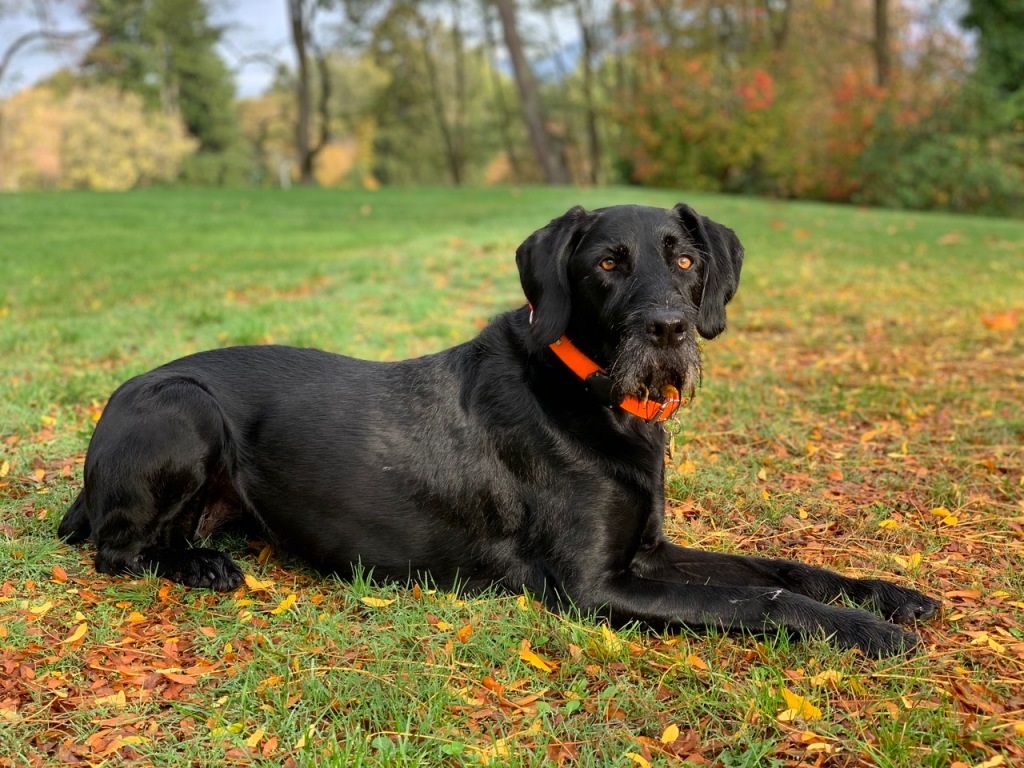
For six years now, I’ve gone on daily walks with Stella, a Giant Schnauzer / Labrador Retriever. We’re out for an hour or two and it never fails: At some point, a phrase from Harry Potter springs to mind: Constant vigilance. CONSTANT VIGILANCE!
I’m always glancing around, scanning our surroundings for potential trouble. Like food scraps on the sidewalk or a dog likely to provoke her. Even when nothing’s amiss, I’m on high alert, controlling her powerful movement. Just under 80 pounds, she’s built like an elite athlete, all lean muscle. If she veers sideways to sniff something or simply stops short, my body is jolted. She could easily pull me off balance. Other dogs do the same thing, but with Stella everything is exaggerated tenfold. Sidewalk slippery with snow/ice/slush? This dog could unintentionally cause my demise.
In her youth, she was tireless, galloping like a horse after her prized Chuckit! balls or swimming deep into English Bay. She takes rest breaks now, sprawling on the grass when we reach our destination, especially on hot summer afternoons. But, even now at age nine, she’s always motoring ahead of me; I must racewalk to match her pace.
When Stella first arrived, we did obedience training classes. She was eager to please and highly motivated. She readily learned commands (and “tricks”), putting on a show with her exaggerated flourishes. But she’d struggle if she had to be still and “do nothing.” In class, I’d be on edge while we waited for each dog to take its turn. If I looked at her, Stella would give me a hard stare, quivering with anticipation. If she barked out of impatience, I’d lead her away, frustrated—a time-out for her and also for me.
I’m not particularly patient myself, and I admit that I’m strict with her. We stopped doing obedience training ages ago, but I still expect her to heel on my left, loose leash—and promptly to respond to cues as if we’re at Westminster or something. Bad behavior during a walk tests my composure. If she loses it, I’m liable lose it as well. Constant vigilance applies to Stella’s actions, but also to my reactions.
I often pass someone holding a leash while checking their phone, drinking coffee, pushing a stroller, chatting, the dog bringing up the rear. When I walk Stella, I’m doing only one thing: walking Stella. I can’t be multitasking. It can be exhausting! We’re all walking our dogs, but we’re experiencing “dog walk” very differently.
Isn’t it similar with yoga asana? For some, yoga poses are approachable, even when strenuous. For others, even everyday poses are fraught and require, yes, constant vigilance.

Being Vigilant in Yoga
I’ve noticed that some yoga students are more prone to injury than others. The same pose that works well for most people somehow tweaks a vulnerable person’s body. Being injury-prone is not necessarily a senior issue, by the way. I have older students who are steady and resilient; younger students who struggle with one mishap after another.
There are myriad causes of injury and pain. I’m not trying to explain why some are prone to it and others not. Rather, I’m wondering if it’s necessarily a bad thing if you must be vigilant.
When I teach a pose that’s potentially risky for a particular student, I remind them to be careful. They can’t mindlessly do yoga. They must constantly be alert. I don’t want them to be overly guarded or to fear movement, the poses, or their body. But they must pay attention and use common sense.
On one hand, constant vigilance seems like a disadvantage, whether in yoga or in dog walking. But is it necessarily negative to be extra careful, to work harder, or to face unusual challenges?
In yoga, agile students sometimes zone out if movement comes easily to them. One of my students habitually rushes into poses. She need not go step by step. In the pose, I must remind her of the stabilizing actions. I often tell her to start over, more slowly and thoughtfully. In contrast, people dealing with constraints are forced to be mindful.
Constant vigilance with Stella isn’t easy, but I’m always 100% present with her. My dog walks are all about her—and that has probably enhanced our relationship. When we attended obedience classes, I consulted our trainer about Stella’s hyper intensity. She emphasized that strong motivation is a plus. Stella is earnest, she can learn, she bonds to her people, she tries her best. It’s up to me—the handler, the human, the adult—to learn how to harness that energy.
Can I view my situation, this constant vigilance, with a positive attitude? What about other, greater challenges in my life?
Be Vigilant But Not Anxious
If you’re the type who must be extra careful doing yoga asana, how can you manage?
- Move deliberately
Once, when I was a beginner, my yoga teacher instructed me to straighten my leg. I moved with such alacrity that she said, “Whoa, don’t move so quickly. You could hurt yourself.” Pay attention as you move. You can move gradually without being a sloth about it.
- Don’t feel pressured by a teacher’s instructions
In Iyengar yoga, teachers are directive and can seem authoritarian. But they aren’t tyrants; they’re always open to adapting poses to individuals. Remember that group instructions are generalities. Never follow instructions that feel harmful to yourself.
- Adapt the pose to your body
Although you attend class to learn conventional or classic poses, you ultimately must create your own practice. Your definition of a pose might be different from the textbook pose—and that’s okay!
- Observe what happens, during and after
Do you do yoga poses based mostly on external cues (teacher’s instructions)? If yes, you must focus on internal cues (sensations, perceptions), both during and after a pose. You can ramp up or down to suit your body. Bear in mind, you might not realize that you’ve pushed too hard until the next day.
- Learn from experience; don’t repeat the same mistake
If you know that a pose could be dicey, do you nevertheless do it in class? (After all, everyone else is doing it.) “Live and learn” is easy to rattle off, but hard to follow. If you want to retry a pose you’ve found tricky, approach it incrementally and hold it briefly. Multiple short holds are safer than a marathon hold.

Images: Stella, West Point Grey Academy, Vancouver, October 2023, Luci Yamamoto.


 Yoga Spy
Leave a Comment