“Could you recommend a yoga book?” a new student, Margot, recently asked. She wanted a basic book to refresh her memory on poses and their names.
I immediately recommended my very first yoga book, Yoga: The Iyengar Way, by Silva, Mira, and Shyam Mehta. As a beginner, I liked the oversized format, clear instructions, giant photos. I liked that the Mehtas, London teachers trained by BKS Iyengar, comprised a mother and her son and daughter. I liked how, in photos, Mira and Shyam looked serious and untrendy, wearing colorful, retro leotards and tights.
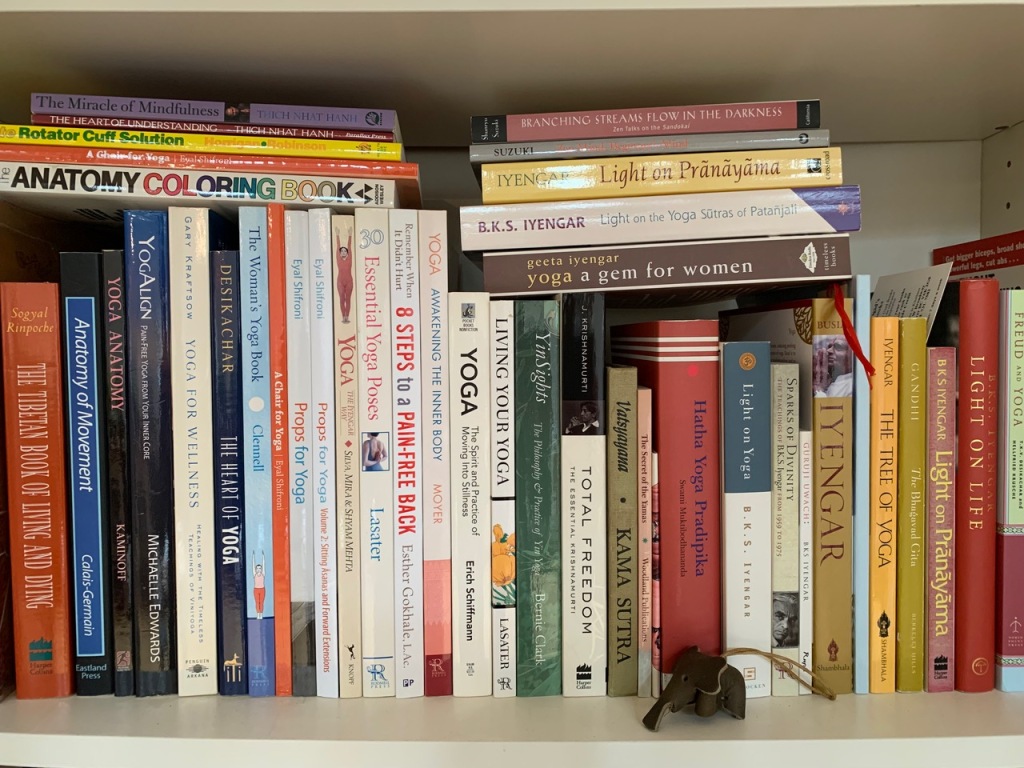
I promised Margot a blog post on yoga books. For starters, from my bookshelf, here are nine recommendations:
- Yoga: The Iyengar Way (1990), Silva, Mira & Shyam Mehta
- Light on Yoga (1966), BKS Iyengar
- The Tree of Yoga (1988), BKS Iyengar
- Light on Life (2005), BKS Iyengar
- Yoga: A Gem for Women (1983), Geeta Iyengar
- The Heart of Yoga (1995), TKV Desikachar
- Yoga Anatomy (2007), Leslie Kaminoff and Amy Matthews
- Yoga: Awakening the Inner Body (2006), Donald Moyer
- A Chair For Yoga (2014), Eyal Shifroni
What’s Your Objective?
My list is the tip of the iceberg. There are hundreds of yoga books out there. I’ve read only a few—and most of my books I acquired as a beginner. I don’t keep track of current releases.
After Margot’s inquiry, I read the New York Times article, “7 Yoga Books to Deepen Your Practice, curious to see what’s touted by the mainstream. Of the seven, I own three, Light on Yoga, The Heart of Yoga, and Yoga Anatomy, all included in my list above. I’m familiar with Autobiography of a Yogi (1946) by Paramahansa Yogananda but haven’t read it.
The three unfamiliar titles share a couple of attributes: First, they’re very new; two were published in 2019 and one in 2020. Second, they reflect today’s concerns with inclusivity and social justice. Yoga books reflect the zeitgeist.
The ideal yoga book for you depends on your objective. Why do you want to read about yoga? To identify poses from class? To memorize Sanskrit words? To understand yoga philosophy? To learn about yoga’s history? To contextualize yoga’s spread from India to the rest of the world?
Of course, this question applies not only to books, but to the practice itself. What is your objective?
A Confession
I have a confession to make. Although I love to read, I’ve never consumed any of my yoga books 100 percent, cover to cover. I might finish a chapter of interest or use them as flip-through resources.
Strange. I’m a big reader. Books, especially fiction, been my solace since childhood. Although I wasn’t an English major, I chose literature courses for electives—and they were always my favorites. Even in law school at Berkeley, I took a course called Law and Literature taught by the late John Jay Osborn, author of The Paper Chase. (In the same vein, I took a course then-called Courts and the Image of Justice in Cinema by Professor Laurent Mayali (see current film syllabus here!).
Not only do I love to read, but I’m also hard-core about “research.” Whether I’m writing a Lonely Planet guide book or trying to identify weird symptoms or shopping for running shoes, I do exhaustive, time-draining research. I like educating myself, and the internet offers almost limitless information.
Why don’t devour yoga books? I’m trying to wrap my mind this dichotomy.
Reading Versus Practicing
Asana/practice books that focus on pose instructions—props, entry and exit, form—can be useful. They can show unfamiliar methods that inspire new ideas. But, for me, a bit of reading goes a long way. I’d say that 90 percent of my teaching comes from my practice—and 10 percent from books. Maybe I’ve always gotten more from practicing yoga than from reading about it.
I need only a kernel of an idea—from my practice, from a book, from another teacher—for inspiration. For example, years ago, I read a Yoga Journal article by Tias Little regarding Ustrasana. One particular instruction—lift the back body (up), relax the front body (down)—seemed contra to the common instruction to “lift the chest.” But to me it made perfect sense. I remember nothing else from the article, but I’ve applied this tidbit in myriad ways ever since.
Likewise, I have a bunch of handwritten journals about classes and workshops taken since 2010. I was so resolute about jotting those notes, but I only rarely flip through them. But, if I do, and if I find an interesting idea, I can run with it for ages. It doesn’t take much. Maybe yoga books are information overload for me!
As for yoga philosophy, do I want to approach it academically or experientially? To be a scholar of yoga philosophy—and overarching Hindu/Vedic philosophy—I’d need to study the classic texts. But to see reality or to live ethically? I’m unconvinced that reading necessarily brings true understanding.
The thing is, book learning is second nature to me. I’m in my element poring over books and words, words, words—and becoming an expert on a subject. But academic learning might only distract me from the underlying existential inquiry. To study philosophy personally, nonacademically, I probably need simpler books and fewer words.
Reading for Pleasure (and More)
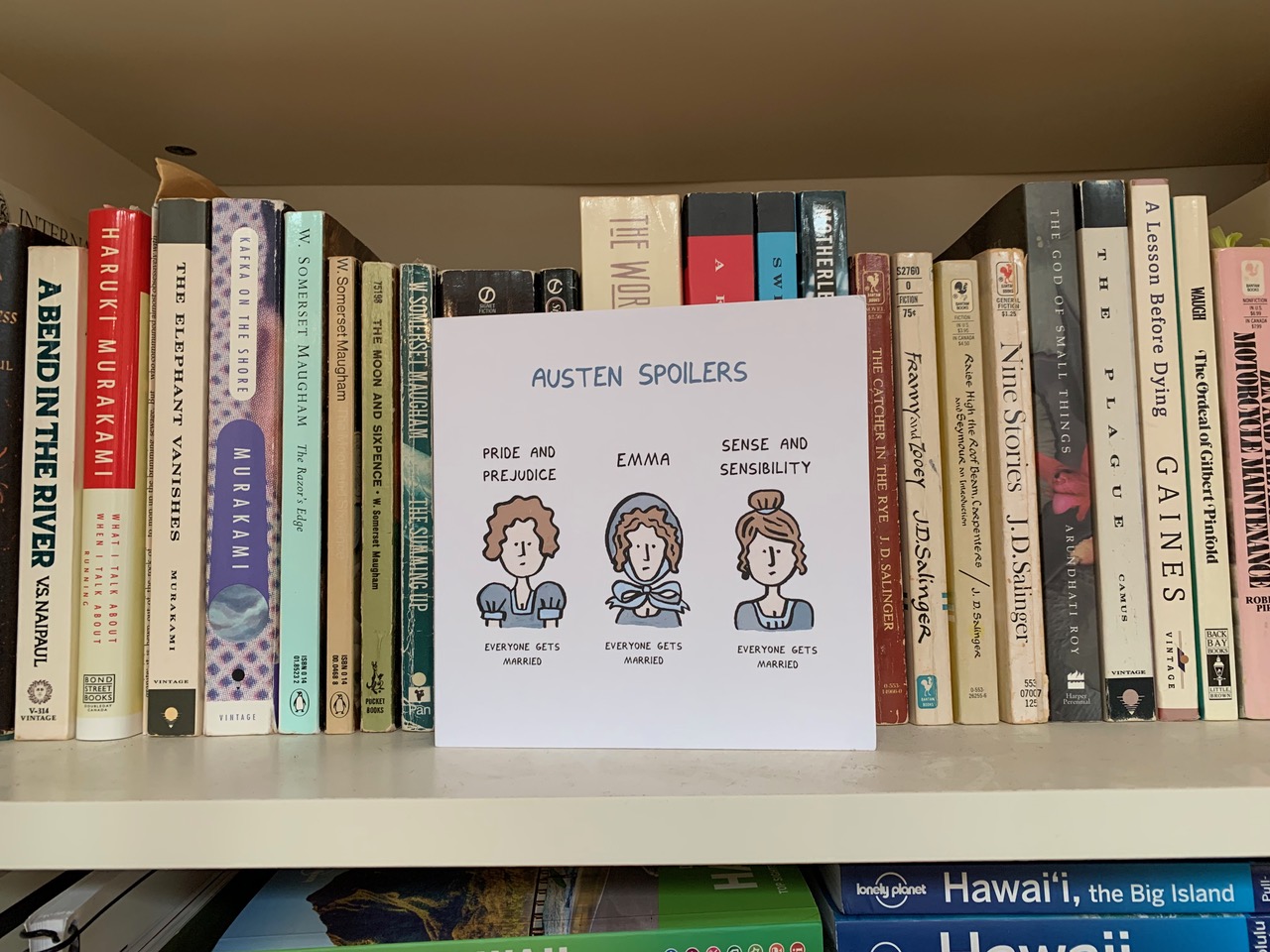
In my free time, I enjoy reading fiction, mostly novels, but also short stories and literary memoirs. (Also, thanks to my niece, I’ve developed real appreciation for youth fiction, including graphic novels and the Harry Potter series, which to me is worthy as adult fiction.) I occasionally fixate on the oeuvre of one author, reading each work in chronological order. W. Somerset Maugham was my first such project after I stumbled upon The Moon and Sixpence, which immediately resonated with me; I got through sixteen of his novels (of varying quality) before moving on. More recently, it was Jane Austen immersion: I read her six novels and watched all of the film adaptations. I’m currently reading Hard-Boiled Wonderland and the End of the World, four novels into my current project, Haruki Murakami—a daunting choice due to his prolific bibliography of lengthy novels and my lack of time for uninterrupted pleasure reading.
I love rereading novels that I read ages ago, like F. Scott Fitzgerald’s The Great Gatsby or William Golding’s Lord of the Flies or, way back, Roald Dahl’s Charlie and the Chocolate Factory. Over the years, you change, your perspective changes—and the story is reborn. During my first year of law school, I’d escape my casebooks every Saturday morning and read Robert Pirsig’s Zen and the Art of Motorcycle Maintenance at the laundromat. Berkeley was the perfect place to question the meaning of life (and what the heck I was doing in law school). Years later, I reread it. Hmm, now might be time for another reread.
Why do I read fiction? Literature helps me to make sense of human nature and the world. It often changes my perspective, challenges my brainpower, gives me courage, and saves my sanity. I’d say that it enriches my yoga life, too.


 Yoga Spy
Leave a Comment