
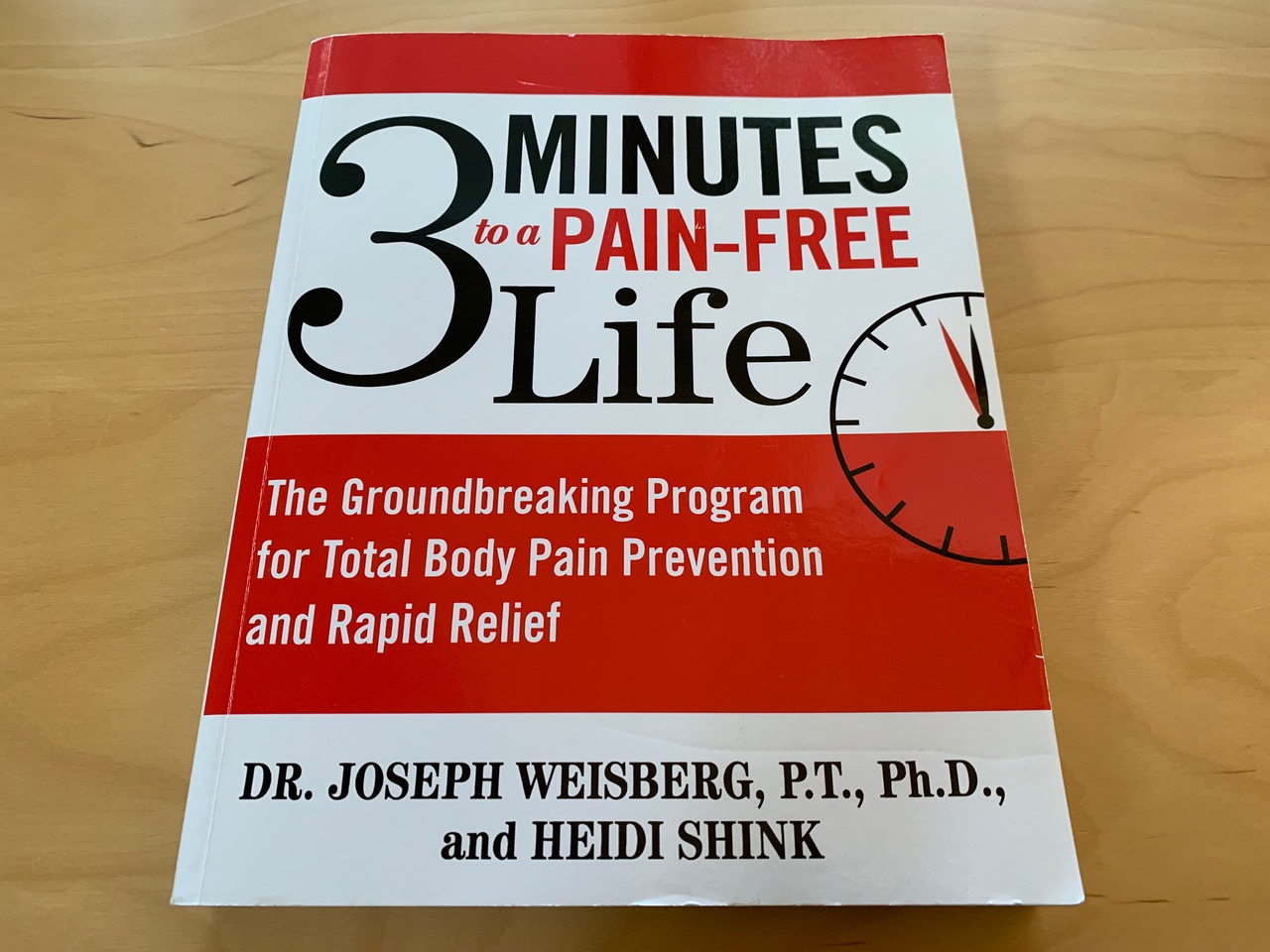
In May, walking past a Little Free Library in Kitsilano, a book title caught my eye: 3 Minutes to a Pain-Free Life. That very day, I was finalizing a blog post on chronic pain. What a coincidence. The book was “like new” and I couldn’t resist taking it.
Written by Joseph Weisberg, a physical therapist, the book contains useful information on pain etiology and management. He believes that joint and muscle dysfunction causes pain that, if unaddressed, can affect the nervous system and become chronic. His recommendation? Movement. Only via movement are joints flushed with synovial fluid and repaired. Likewise, movement forces muscles to lengthen and to contract, both which keep them functional.
Weisberg provides dozens of exercises, which he calls “therapeutic movements,” targeting body parts from head to toe. In this post, I’ll focus on his basic, daily, three-minute sequence to prevent chronic pain.
The sequence comprises six movements that resemble yoga poses. They take major joints through full range of motion and major muscles toward full elongation.
The hook is the time frame. Remember the title? Three minutes. Each movement is held only for thirty seconds.
Here’s the sequence, which should be done as ordered. In parentheses I include names of similar yoga poses.
- Bow (Adho Mukha Virasana, Child’s pose)
- Arch (Cat-Cow pose) Ten repeats.
- Lizard (Bhujangasana, Cobra pose) Feet apart.
- Natural Squat (Malasana, Garland pose) Feet apart.
- Split (Prasarita Padottanasana, wide-legged forward bend) Hold upright stance before bending forward.
- Sky Reach (Sukhasana, cross-legged sitting, with Parvatasana, arms overhead with clasped hands)
I scrutinized the photos of people demonstrating each movement. I must admit to looking askance at the models’ form in Lizard and Split; I had an urge to take my hands and adjust their bodies! But Weisberg’s instructions are sound and clear—and I appreciate that he explains why each movement is beneficial.
Out of curiosity, I tried the sequence a couple of times. It was easy—in the best sense of the word. I liked the variety of movements. I loved the utterly doable time frame. Even when I have absolutely no time, I can squeeze in this mini sequence.
It became my daily starter, tweaked here and there, from day to day. I typically do much longer holds, multiple repeats, additional poses, substitute poses. Examples:
- Do Cat-Cow pose in dramatically slow motion.
- Substitute Sphinx (elbows grounded) and Seal (straight arms, but hands farther forward) poses for classic Cobra pose.
- Do Tadasana with Urdhva Hastasana and Utkatasana before Malasana.
- Look down and then up in Sukhasana with Parvatasana.
For me, the sequence takes at least 20 minutes, not three. But I always have the option to cut back. What a relief to have a doable daily task.
This book is worth a read as an introduction to pain medicine and for physical therapy exercises. In addition to his basic three-minute sequence, he presents those specialized for athletes, for pregnant women, for seniors, and for children.
You might quibble with Weisberg’s chosen six movements and have your own preferred lineup. But the nitty-gritty sequence is not the key idea.
The takeaway is minimalism. A daily task sounds daunting until you know that it can be done in three minutes. Then it’s doable. It’s minimal and infallible. It’s an excellent starting point.
Related Reading
Atomic Habits, James Clear
One Small Step Can Change Your Life: The Kaizen Way, Robert Maurer

Images: Little Free Library, W 6th Ave at Dunbar St, Kitsilano, Vancouver, May 2022, Luci Yamamoto.


 Yoga Spy
Leave a Comment