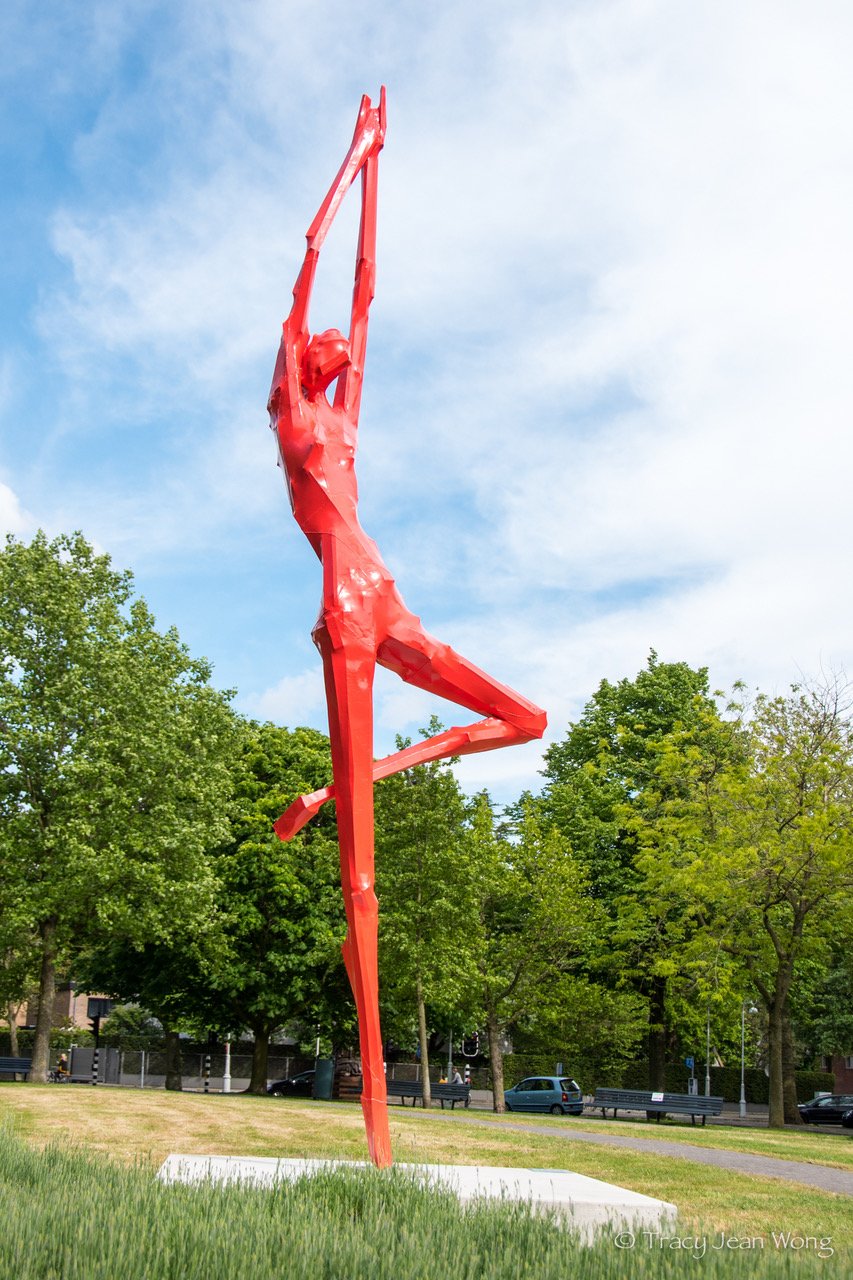
The first one-legged balance pose that I learned was Vrksasana (Tree pose). It was doable, although somewhat unpredictable and nerve-wracking. There’s no mistaking if you’re standing—or not.
Over the years, I made friends with Tree pose, so aptly named. I now practice and teach it regularly. During the pandemic, Vrksasana made it into my heavy rotation. Initially my routine was to hold the pose for two minutes, three sets, alternating right and left sides. Sometimes I’d do three-minute holds, two sets.
I used a timer—my watch or my phone—for consistency. It might seem rigid, repetitive, or somehow un-yogic to time a pose. But, for me, setting a timer is liberating. In the constraints of an established time frame, I’m free. No need for planning, deciding, negotiating. Simply do the pose.
Sometimes I’d do five straight minutes per side. One January morning, a few weeks ago, the timer beeped and, still standing in Tree pose, I reset it. That day, Vrksasana felt easy, and I held it for another five minutes. I tried the pose on my other leg—and likewise held it for 10 minutes.
In 20+ years of yoga practice, I’d never tried a 10-minute Vrksasana before. In fact, I’d assumed that 10 minutes was impossible. To my surprise, since that January discovery, I’ve done numerous 10-minute Vrksasana holds, on each leg, one after the other. The impossible has become possible. What was previously limiting me?
I got to thinking about long holds—and about trying new things.
What Needs Work?
Holding a pose takes tenacity, physically and mentally. Sometimes, the weakness is in the body; sometimes, in the mind.
In Tree pose, do you struggle with balance? Or muscular fatigue? Or mental fatigue? With practice, most people can learn to stand on one leg. But, over time, either the muscles burn with lactic acid buildup or the brain gets distracted, anxious, or just plain bored. At this point, we often shrug and give up.
Relax Mind and Body
Mental stamina is underrated. We usually blame asana weaknesses on physical factors—and sometimes we’re right. We can’t heal injuries overnight or change innate abilities. But, if you can do Vrksasana for one minute, why can’t you hold it for two or five or more?
For me, it helps to be relaxed. While deep concentration is essential to yoga, it can be counterproductive: too much pressure. I sometimes utilize varied, rather than pointed, focus.
In holding Vrksasana, for example, part of my brain is fixed on my standing leg—and on my breath. But other parts of my brain engage with my arms, my eyes, my ears. I vary my arm positions—Namaskarasana, Urdhva Hastasana, Paschima Namaskarasana—shifting my attention throughout my body. I let my mind absorb the sights outside my window, the sounds of music playing on my stereo. By not staring down my balance leg, it relaxes; I relax.
Find “Flow”
There’s a well-known story about Abhijata Iyengar’s youthful quest to hold Sirsasana (Headstand) for 20 minutes to impress her grandfather, BKS Iyengar. Setting a timer, she forced herself to stay upside-down, counting down the minutes. When she proudly announced her feat to her grandfather, he asked, “What did you do in the pose?”
She had no answer. “I was just doing the pose. I was doing… nothing in the pose.”
“Then you wasted your time,” he said.
In telling her story, Abhijata explained that her grandfather holds a pose to find the pose—not to achieve a time goal.
I appreciate that idea. (It reminds me of the psychological concept of “flow,” set forth by Mihaly Csikszentmihalyi, professor and author of Flow: The Psychology of Optimal Experience.)
Although I set a timer, I actually ignore it during the pose. To hold Vrksasana for 10 minutes, I must reach a steady state—calm, quiet, stable, as if I could continue indefinitely. If agitated and fighting the pose, I’m doing boot camp yoga.
Try Something New
By “new,” I don’t necessarily mean unfamiliar, tricky poses. We can do familiar, basic poses in different ways that change our assumptions. Each pose is large, each pose contains multitudes.
In my early years practicing yoga—and also while training for higher certification levels—I was eager to learn new poses. Some of these poses were strenuous, requiring sufficient prep work and recovery time.
Currently, my day-to-day practice is less about advanced “back of the book” poses—and more about solid, consistent basics, such as Sirsasana, Sarvangasana (Shoulderstand), Surya Namascar (Sun Salutations), Gomukhasana (Cow Face pose), and, yes, Vrksasana. One reason is time. Asana is important, but it’s one priority among many. A related reason is injury prevention. If I have less than an hour for yoga, I’d rather hone my core practice than push too fast toward my limits.
Familiar poses can be advanced by trying other props (or no props), other entries and exits, other sequences. And advancement need not be physical. If compromised in the body, we can delve into restorative poses—or practice pranayama and meditation.
One day I might try closing my eyes during asana. My friend Keith is an avid Ashtanga yoga practitioner (he does 108 Surya Namaskar B daily) and he’s blind. He took up yoga five or six years after her lost his sight as an adult. Can you imagine learning asana without vision? Holding a pose with eyes closed even briefly might test my composure—and teach me something.
If nothing else, simply hold a pose longer than usual. It can be transformative.
Image: Artzuid, International Sculpture Route Amsterdam, Netherlands, May 2015, Tracy Jean Wong.


 Yoga Spy
Leave a reply to bcelaine Cancel reply