Part 2 of a three-part series
Some argue that the demo method turns off younger students because it’s slower paced. Occasionally I hear “directives” from Iyengar yoga associations that teaching should be more dynamic—more jumping around and tricky poses—to attract young people.
On one hand, this idea makes sense. Twentysomethings are generally healthy and eager to progress physically. On the other hand, it assumes a lot. I surveyed my students about in-class demos and those in their 20s to 30s quite like demos and step-by-step teaching. They’ve tried and rejected mega classes with no demos, no corrections. They do other activities—jogging, cycling, weightlifting, Zumba—to work out. They’re seeking something else, some way to complement life in general.
Have you noticed that Iyengar yoga appeals to a particular mindset? It takes a degree of maturity to appreciate Iyengar yoga—and this maturity is typically, but not necessarily, linked to age. Detailed instructions, close observations, willingness to be corrected, precision, subtlety, stillness. It’s not to everyone’s taste.
Fast Versus Slow Pace
Is Iyengar yoga fundamentally faster paced—or slower paced? Although I’m relatively dynamic in my teaching style and a bit leery of overanalysis and “too many demos,” I believe that Iyengar yoga is not a fast-paced method. That would be Pattabhi Jois’s Ashtanga yoga, marked by vigorous set sequences of multiple repetitions with shorter holds. In Iyengar yoga, precise form and longer holds are essential. And demos, whether many or few, whether “come and watch” or “follow the leader,” are part of the process.
If slower pace turns off those seeking flow yoga, so what? Why cater to what might appeal to this or that group?
Early in my teaching career, I had a student who had done other types of yoga before trying my classes. She was attentive and regular but, after a couple of years, said that she misses the constant movement of flow yoga. I regularly included Sun Salutations (which are integral to my own practice) and flowing sequences, but certainly not every time—and my emphasis was on alignment and individual correction.
As a new teacher, I immediately questioned myself. Should I include more nonstop vinyasa? Am I turning off potential students? I’ve long outgrown that mentality. I teach according to who I am. I can’t be everything to everyone.
As to methods, there may be a million and then some, but principles are few. The man who grasps principles can successfully select his own methods. The man who tries methods, ignoring principles, is sure to have trouble.
Harrington Emerson
Different Styles, Similarly Effective
Demos and slower pace are, arguably, elements of Iyengar yoga teaching, but they’re not “one size fits all.” Teachers have natural inclinations and should teach accordingly. They must find their own style and not copy others or cater to what’s popular.
If I recall the teachers who have influenced me, they vary in teaching style. If I sense that I can really learn from someone, I accept their style. If authentic, any style can be effective.
My very first yoga teacher was Sandy Blaine. In Berkeley in the late 1990s, I took one class with her, and I was hooked. I don’t recall Sandy’s teaching being demo heavy because her sequences had a steady, fluid quality. After each class, I’d fall into deep Savasana—my body temperature would palpably drop, and my mind would enter that liminal zone. I’d feel drained and yet exhilarated, as if I’d gone on a journey.
But Sandy must have demo’d because I first learned almost every pose from her. She was adept in asana; watching her was inspiring. I was a regular at her studio. Our core group of 10 or so had an easy camaraderie, so trying new poses, even tricky ones, wasn’t intimidating. The vibe surely reflected Sandy’s warm, open personality.
Rather than frequently stopping to do a “come and watch” student demos, she more often demo’d herself and then manually adjusted our bodies. She had a perceptive eye and a confident touch; her adjustments clearly indicated what I needed to do. Sandy was the perfect conduit to yoga for me.
Back then, I also studied with the late Donald Moyer of the Yoga Room in Berkeley. Donald was a maestro of the “student demo”—in which he used students as case studies to illustrate a concept. In class, we often had to gather and watch, carefully, else miss the point. His thinking was subtle, targeting specific muscles and bones and the “inner body.” His quirky sense of humor kept his intricate, even esoteric, teaching lighthearted.
Because close observation was his forte, Donald’s emphasis on demos made sense. It matched his knowledge and his manner. At the Yoga Room’s annual summer intensive, he’d invite each participant to choose one pose to work on. Then, each day, he’d guide a couple of participants in their chosen poses while classmates observed. The intensives were geared for experienced practitioners, including many teachers, who understood demos. But he included student demos in his general classes, too.
I must admit that long demos sometimes tried my patience. But I always valued Donald’s detailed, demo-oriented teaching. I knew, even as a beginner, that I wouldn’t find another teacher quite like him.
I describe Sandy and Donald to show that different teaching styles can be similarly effective. But the style must come naturally to the teacher. It’s excruciating to watch an analytical demo by someone with nothing original and interesting to convey.
In debating the demo method, it sounds as if we’re judging its merits. It sounds as if there’s one best way to teach. That’s misguided. There’s no right or wrong way, as I try to show via Sandy and Donald.
Iyengar yoga teachers share the same basic principles. We are certified based on rigorous, specific, and uniform training. But how we teach? What a pity if our teaching styles, like our training, were uniform!

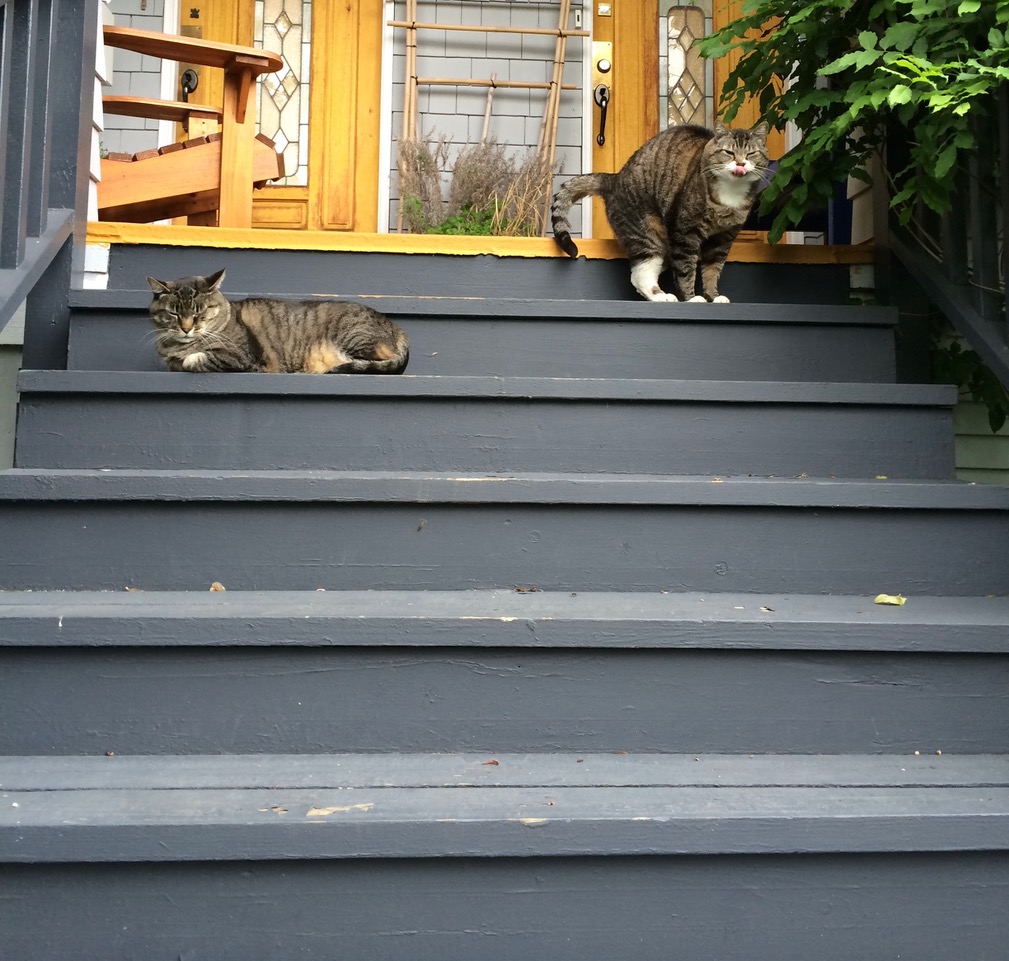
Images: I never tire of watching cats. Their physicality is compelling, their composure even more so. They know exactly what they like and what they dislike. They know when to leap, when to let go. Watching a cat in repose is an impeccable demonstration of restorative yoga.
Pictured in this series are Shey and Tai. Born in 2001, they were brothers and lifelong companions who lived for more than 16 years with my yoga colleague Valerie Speidel, Studio-be. I was delighted to find them together at home in Kitsilano, Vancouver, in May 2014.


 Yoga Spy
Leave a reply to Luci Yamamoto Cancel reply